Anthony Cox
I have
previously
written about the fact that the heat in the ocean isn’t there. A Facebook
commentator produced some excellent graphs based on the ARGO data which showed
NO heat accumulation at any level in the world’s oceans. This lack of warming
contradicts
completely (Anthropogenic Global Warming) AGW theory as put forward by such AGW stalwarts as Trenberth and
England. It also has
Hansen
scrambling for weird and whacky explanations.
So it is plain in the ARGO era that the oceans are not
warming and this contradicts AGW.
In my articles I noted that NODC graphs were shown in joules
which allowed a steeper slope compared to a temperature trend. Mischievously I
suggested an ulterior motive for this. Alarmism.
Another blogger has taken me to task.
Rob
Ryan has defended the NODC graphs and pointed out that they do indeed have
temperature graphs. Indeed they do:
Thanks Rob. By way of comparison here is the same graph in
joules:
Well to me the trend slope in the joules graph looks steeper
and more alarming than the temperature graph. But Rob doesn’t like OHC as a
measure of the energy; it is poor
terminology according to Rob. Hey Rob, don’t blame me, argue with NODC and
indeed AGW in general; they’re the ones using and relying on it.
What really is poor is the notion that by any measure the
oceans are heating. The estimable
Bob
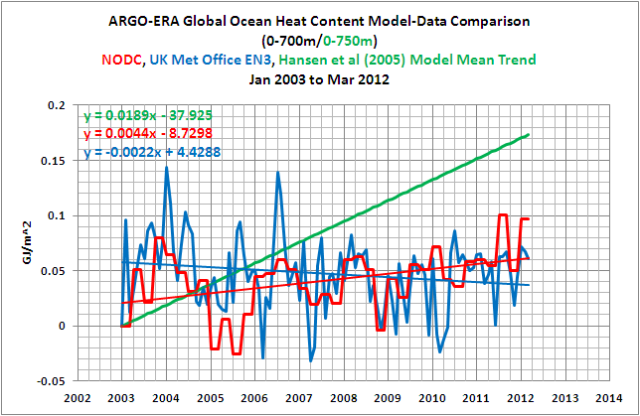
Tisdale does a comparison of all OHC measures and produces this graph:
Plainly Hansen’s model on behalf of AGW is off with the
pixies while the MET and the NODC show the opposite trend!
A couple of things about this.
At the 700 meters range NODC have increased the trend by 19%.
The NODC adjustments increase the trend at 2000 meters by 36%!
Secondly the ARGO data, even though it is the best we have
ever had, is vastly insufficient.
Willis
Eschenbach notes:
- The sampling of the oceans is by no means
as uniform as I had expected. Part of the ocean is under sampled, sometimes
badly so, compared to other areas. Half of the global ocean has been sampled
less than 20 times per 10,000 sq. km, and 14% has never been sampled by Argo
floats at all.
- Even when we look at just the area from
60°N/S, half the ocean has been sampled less than 24 times per 10,000 sq. km,
and 8% is unsampled.
- The area of the El Nino phenomenon is a
critical area for the regulation of planetary heat loss. Oceanic heat content
in this area can change quite rapidly. However, parts of it are woefully
undersampled.
- Finally, the older Argo floats sample
either down to 1,000 metres, and intermittently go to 1,500 metres depth. The
newer ones go down to 1800 metres. Which is quite deep, about a mile down. But
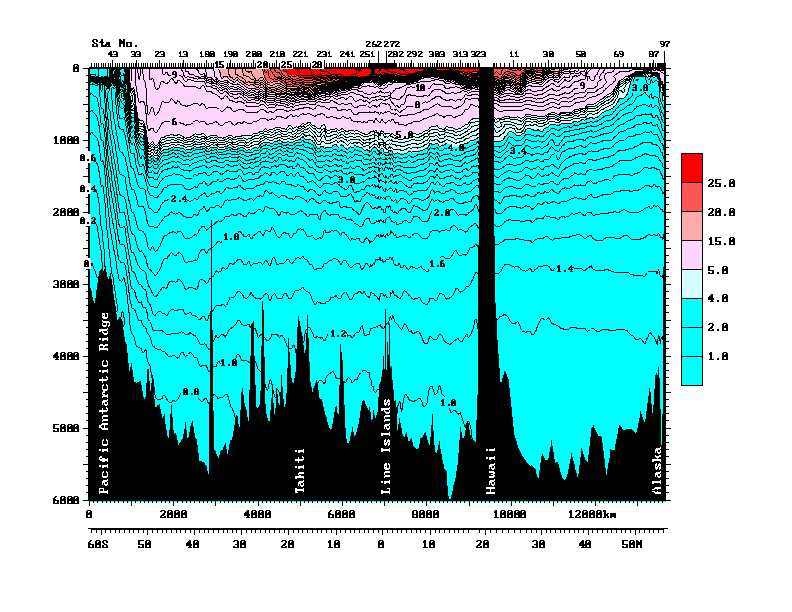
the estimates of oceanic heat storage include the whole ocean. Figure 3 shows a
pair of transects from Antarctica (on the left) to Hawaii, and then Hawaii to
Alaska on the right, to give some sense of scale.

Figure 3 (Figure 10 from cited
source.) North/South Pacific transect at 150°W. ORIGINAL CAPTION:
Vertical section of potential temperature (°C) along 150°W from data collected
in 1991-1993 as part of the World Ocean Circulation Experiment. Data north of
Hawaii were collected in 1984 (Talley et al., 1991). Potential temperature is
the temperature a parcel of water would have if moved to the sea surface with
no change in heat content, and is lower than measured temperature since
temperature increases when water is compressed due to the high pressure in the
ocean. Source and Image
The Argo floats operate mostly in the
warmer area up top of Figure 3, above the lower thermocline (light blue).
Average depth in this entire transect is much deeper than that, about 5,000
metres. So the Argo floats are measuring less than a quarter of the water in
this part of the Pacific basin. Makes the whole question of oceanic heat
content kinda iffy.
Kinda iffy is a
vast understatement! The ARGO floats don’t even go to 2000 meters and yet we
have temperature profiles at that depth.
The only reasonable conclusion is that based on the best
data from ARGO the oceans are not warming, whether you are considering joules
or temperature.
Thanks again Rob; by my reckoning that is another nail in
the AGW coffin.